I worked at Adobe Systems first in 1985, before PageMaker 1.0 was available. In those days software was copy protected through various means, all of which were nefarious. Aldus used to drill holes in the floppy disks and the installer would look for the bad disk sector to correspond to it.
Copy II Mac was a free utility that defeated copy protection easily. If you wanted a free copy of PageMaker, or any other app, you could get one.
<rant>
22 years later, the situation is different, but the outcome is the same. If you actually buy a legal copy of software, you are either inconvenienced or completely incapacitated at least once by the copy protection (now called "activation"). I have a legal copy of Adobe InDesign CS3, and my computer freaked out so I bought a new computer and transferred all my stuff to it. I launched InDesign and it told me I needed to reactivate the software, but wouldn't let me because my old (dead) computer was still on the list. Instead of a nice easy way to say "transfer one of these licenses to your new computer" maybe with a nice list of my activated computers, it just told me I couldn't do it, and needed to call the 800 number. I've called twice (it's 9:00pm on a Friday night), gotten no one on the phone, but I've entered well over ONE HUNDRED digits on my phone accompanied by many # keys to confirm that no, I can't activate this computer.
They give me 5 days to solve the problem, which is better than shutting me down. But they put the onus on ME, the paying customer, to do all the work of reading or typing in all these god-forsaken keys into the phone or the activation screen. They are punishing me, again, for being a paying customer. And if I don't get this resolved in the next 5 days, on my time, calling and entering numbers and waiting, then I can't use the software that I paid for. The frustration level is very high.
The true criminals have a much easier time of it: they just go get an illegal key off the internet somewhere and away they go.
For a while there, maybe a good decade, everybody had done away with copy protection because it was well known that it punished the wrong people. It's come back, and it's as bad as ever. I guess there's a new generation of people now who really do believe they can prevent software piracy, and all they have to do is get the customers to enter 30-digit numbers. They're wrong, as were their forebears. I don't know if I can wait for the next cycle of anti-copy-protected software to come along.
</rant>
Friday, October 26, 2007


Wednesday, October 24, 2007
GMail security (or lack thereof)

I have a GMail account. I don't use it. I don't like Google's policies about keeping/filtering email. But I have a GMail account. Maybe one day I'll use it. They sort of force you to have one to do a lot of things, such as blogging on Blogger, which this blog is. Sigh.
Anyway, today I logged in to my GMail account, out of curiosity to see if I had any mail. I have a WHOLE LOT of spam, which is what prompts this blog post. 738 messages, as you can see in the screen shot to the left.
I have not given out my GMail account to anyone. I never send mail from that account. I use it only to log into Blogger, to save maps in Google maps, etc. So really the only entity that has my GMail address is Google. Evidently, they have been hacked/compromised or else they're selling my email address to the spammers directly. How else would this email address wind up on spam lists?! I tried searching for it (my address, and no, I'm not posting it here for spambots to harvest). There is no way I can think of for a spambot to have gotten this email address except through Google itself.
Kind of scary. Now I'm really not going to use my GMail account.
Tuesday, October 09, 2007
Sky divers die in plane crash

It strikes me as extremely ironic that the plane crash today was 10 members of a skydiving company, all of whom apparently were in the plane when it hit the ground. You'd think they'd jump out, with parachutes, wouldn't you?
Sunday, September 30, 2007
iMovie 08 doesn't cut it
I'm the guy who created the version version of Apple's iMovie back in 1998 so my thoughts about the new iMovie might be biased. On the other hand, I know a lot about software and movie editing.
Apple tossed out iMovie this year and rewrote it from scratch. They got it wrong. The new iMovie... well, it sucks. I still have friends on the iMovie team (for a little while longer, at least), but I don't care. I'm going to blast it anyway, as the piece of useless eye-candy junk that it is.
I have a lot of specific reasons as to why that is the case. It's not just the missing features, or the fact that it can't even open an existing iMovie project, which is Cardinal Sin #1 in any advanced version of a project- or document-based software product.
I did a brief test run with the new iMovie, which I will heretofore call "iTube", because it shouldn't really be called iMovie. I put it through some quick paces, found an inordinate number of bugs, and gave up. But I remained silent, because I had a feeling that I was just being negative since they had just thrown my baby out with the bath water.
But today my daughter, who is 11, and who has a brand new iMac, asked for help with iMovie, since she knew I had created it. I saw that she was in fact using "iTube", and she was confused. She had shot some DV footage with a friend and wanted to edit it. I watched. As user experiences go, it was an unmitigated disaster. Georgia, a competent 6th grader, and her friend, a high school sophomore, could not do anything useful with the program. They had trouble importing the footage, because the "Automatic" mode simply didn't work. An uplug/replug of the camer and switch to Manual mode fixed the import. But that was just the beginning of the issues. There were an incredible number of individual clips, or "Events", since the girls were trigger happy in turning the camera on and off. They couldn't figure out what they were supposed to do, what they were looking at, or even how to "play the movie", which is of course the first thing you want to do after you import footage.
The first thing I noticed is that you simply can't "scrub" through a movie any more. The clips are arranged with carriage returns every so many clips, instead of in a linear fashion, so you simply cannot drag the cursor through the entire movie, because there's no way to navigate through one of the carriage returns (going from the far right end of one line of clips to the left of the next line of clips). The "Skimming" feature goes from novel but useless to annoying in about 5 minutes. It is activated simply by mousing over footage, so as you move the mouse around the program, the screen is constantly moving around on you, moving your point of reference in the movie, and pissing you off. There's simply no way to navigate through the footage!
I have heard the argument as to why the new "iTube" was necessary. Editing movies is too hard. Nobody does it. It needed to be simplified (again). This is all true. But it's not the editor itself that was or is the problem. It's because video is a time-based medium; therefore it takes TIME to edit it. There's no way around that.
Consider this... You've shot 1 hour of video footage on your camera. You come home and decide you want to make something out of it to show your friends or family. It takes 1 hour to import the footage into your computer. It takes another hour to watch it through once. If you stop, start, and enjoy it at all, it'll take you more than 1 hour. If you do NO EDITING at all, and decide to burn it straight to a DVD, or upload it to uTube, it will take you another hour in production time. You're THREE HOURS into the project and you haven't done a single edit. It's my contention that, if you're going to invest hours in just getting the footage from one place to another, and you don't edit it, you're missing the fun part. To scrub through video footage, play snippets, cut out the bad parts, pull it together into something presentable, is fun. Yes, it's time consuming, but it's fun, and rewarding.
The whole premise of "iTube" seems to be that you should short-cut the editing down to simply arranging clips and maybe throwing in some music, because, as the story goes, it was too hard to do that before. Well, after almost 10 years of people loving iMovie and making some pretty amazing movies with it, I have to disagree that it was too hard to use, and that was what was making people not edit their video footage.
Back to my critique of "iTube".
There's no timeline view, which on the surface seems like a "power user" feature. It is. But since video is time-based, if you're even a little bit interested in editing it, you start understanding the timeline and using it. If you're adding music or sound, it's critical to be able to operate in a linear time-based view. There's no way around it, I don't think. Just removing the feature isn't a way around it.
The idea of an "Event Library" is a pro feature. It doesn't map to the way families and amateurs create and reuse video. A clip/event library presumes that you have a lot of beautifully-shot, well-lit clips that can be rearranged to tell a story, or to compel people to vote for you in the Oscars. If you have a 3rd Birthday Party on one DV tape and a Trip to Yosemite on another, are you really going to love all that footage being in a Library so you can re-use it to make your masterpiece of cinema. No, you're not.
The "iTube" interface is very cluttered. There are a whole bunch of rectangles with unclear purpose, a lot of thumbnails and pieces of video everywhere you look, but no clear sense of what is your "movie" and what is not. Gone is the simplicity of One Big Window showing your movie, and a simple list of clips that comprise that movie. How is this new interface "simpler" or "easier to use" or "better"? There isn't a single thing to recommend it, and it violates all sorts of basic principles of Human Interface Design.
There is a tool bar in the center of the window (now there's innovation!) with commands that loosely map to menu commands, as all toolbars do, but you can't customize the toolbar, which has been a toolbar staple for about 15 years now. Nor can you figure out what any of the icons mean without the tool tips. Icons were supposed to be superior to text menus, but in this case I'd rather just use the menus. The first icon in the list, one that you instinctively mouse over to see what this new app is all about, says, "Add Selection to Project". The next one says, "Mark Selection as Favorite". Ummmm, okay, whatever. What selection? What project?
My favorite icon/button is a double-arrow that looks like a recycling icon that says "Swap Events and Projects". This lets you customize that one aspect of the interface, oddly, since no other aspect is customizable. It also suggests that Apple is not confident that the Events and Projects rectangles are in the right place. Why would you make it so easy to swap them? Why would you use a very prominent button in the user interface for something which you should probably never do, and at best will do once in the lifetime of owning the program? It's a fricking preference, not a major button in the interface.
The whole thing is incredibly poorly thought-out, hard to use, annoying, and, at the end of the day, not really a movie editor at all.
This app should have been called iTube 0.8, not iMovie '08. It's certainly a 0.8 app, not a 1.0 app, and it's certainly not iMovie.
Apple tossed out iMovie this year and rewrote it from scratch. They got it wrong. The new iMovie... well, it sucks. I still have friends on the iMovie team (for a little while longer, at least), but I don't care. I'm going to blast it anyway, as the piece of useless eye-candy junk that it is.
I have a lot of specific reasons as to why that is the case. It's not just the missing features, or the fact that it can't even open an existing iMovie project, which is Cardinal Sin #1 in any advanced version of a project- or document-based software product.
I did a brief test run with the new iMovie, which I will heretofore call "iTube", because it shouldn't really be called iMovie. I put it through some quick paces, found an inordinate number of bugs, and gave up. But I remained silent, because I had a feeling that I was just being negative since they had just thrown my baby out with the bath water.
But today my daughter, who is 11, and who has a brand new iMac, asked for help with iMovie, since she knew I had created it. I saw that she was in fact using "iTube", and she was confused. She had shot some DV footage with a friend and wanted to edit it. I watched. As user experiences go, it was an unmitigated disaster. Georgia, a competent 6th grader, and her friend, a high school sophomore, could not do anything useful with the program. They had trouble importing the footage, because the "Automatic" mode simply didn't work. An uplug/replug of the camer and switch to Manual mode fixed the import. But that was just the beginning of the issues. There were an incredible number of individual clips, or "Events", since the girls were trigger happy in turning the camera on and off. They couldn't figure out what they were supposed to do, what they were looking at, or even how to "play the movie", which is of course the first thing you want to do after you import footage.
The first thing I noticed is that you simply can't "scrub" through a movie any more. The clips are arranged with carriage returns every so many clips, instead of in a linear fashion, so you simply cannot drag the cursor through the entire movie, because there's no way to navigate through one of the carriage returns (going from the far right end of one line of clips to the left of the next line of clips). The "Skimming" feature goes from novel but useless to annoying in about 5 minutes. It is activated simply by mousing over footage, so as you move the mouse around the program, the screen is constantly moving around on you, moving your point of reference in the movie, and pissing you off. There's simply no way to navigate through the footage!
I have heard the argument as to why the new "iTube" was necessary. Editing movies is too hard. Nobody does it. It needed to be simplified (again). This is all true. But it's not the editor itself that was or is the problem. It's because video is a time-based medium; therefore it takes TIME to edit it. There's no way around that.
Consider this... You've shot 1 hour of video footage on your camera. You come home and decide you want to make something out of it to show your friends or family. It takes 1 hour to import the footage into your computer. It takes another hour to watch it through once. If you stop, start, and enjoy it at all, it'll take you more than 1 hour. If you do NO EDITING at all, and decide to burn it straight to a DVD, or upload it to uTube, it will take you another hour in production time. You're THREE HOURS into the project and you haven't done a single edit. It's my contention that, if you're going to invest hours in just getting the footage from one place to another, and you don't edit it, you're missing the fun part. To scrub through video footage, play snippets, cut out the bad parts, pull it together into something presentable, is fun. Yes, it's time consuming, but it's fun, and rewarding.
The whole premise of "iTube" seems to be that you should short-cut the editing down to simply arranging clips and maybe throwing in some music, because, as the story goes, it was too hard to do that before. Well, after almost 10 years of people loving iMovie and making some pretty amazing movies with it, I have to disagree that it was too hard to use, and that was what was making people not edit their video footage.
Back to my critique of "iTube".
There's no timeline view, which on the surface seems like a "power user" feature. It is. But since video is time-based, if you're even a little bit interested in editing it, you start understanding the timeline and using it. If you're adding music or sound, it's critical to be able to operate in a linear time-based view. There's no way around it, I don't think. Just removing the feature isn't a way around it.
The idea of an "Event Library" is a pro feature. It doesn't map to the way families and amateurs create and reuse video. A clip/event library presumes that you have a lot of beautifully-shot, well-lit clips that can be rearranged to tell a story, or to compel people to vote for you in the Oscars. If you have a 3rd Birthday Party on one DV tape and a Trip to Yosemite on another, are you really going to love all that footage being in a Library so you can re-use it to make your masterpiece of cinema. No, you're not.
The "iTube" interface is very cluttered. There are a whole bunch of rectangles with unclear purpose, a lot of thumbnails and pieces of video everywhere you look, but no clear sense of what is your "movie" and what is not. Gone is the simplicity of One Big Window showing your movie, and a simple list of clips that comprise that movie. How is this new interface "simpler" or "easier to use" or "better"? There isn't a single thing to recommend it, and it violates all sorts of basic principles of Human Interface Design.
There is a tool bar in the center of the window (now there's innovation!) with commands that loosely map to menu commands, as all toolbars do, but you can't customize the toolbar, which has been a toolbar staple for about 15 years now. Nor can you figure out what any of the icons mean without the tool tips. Icons were supposed to be superior to text menus, but in this case I'd rather just use the menus. The first icon in the list, one that you instinctively mouse over to see what this new app is all about, says, "Add Selection to Project". The next one says, "Mark Selection as Favorite". Ummmm, okay, whatever. What selection? What project?
My favorite icon/button is a double-arrow that looks like a recycling icon that says "Swap Events and Projects". This lets you customize that one aspect of the interface, oddly, since no other aspect is customizable. It also suggests that Apple is not confident that the Events and Projects rectangles are in the right place. Why would you make it so easy to swap them? Why would you use a very prominent button in the user interface for something which you should probably never do, and at best will do once in the lifetime of owning the program? It's a fricking preference, not a major button in the interface.
The whole thing is incredibly poorly thought-out, hard to use, annoying, and, at the end of the day, not really a movie editor at all.
This app should have been called iTube 0.8, not iMovie '08. It's certainly a 0.8 app, not a 1.0 app, and it's certainly not iMovie.
Monday, September 24, 2007
Tesla Motors spotting
Today I spotted a prototype Tesla car up on Skyline Blvd. I had rushed over to talk to whoever it was, but it was clear that an interview was in progress so I didn't interrupt. The car looks very cool when you're next to it; a little smaller than I had imagined, but cool.
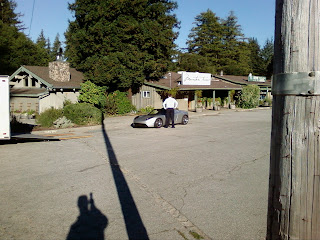
The best part was when the truck/trailer that was hauling the car up to Skyline stopped to refuel. Something very ironic about a Tesla vehicle stopped at a gas pump.

I asked the guy if I could buy what he had in his trailer, but he said it was an "unsaleable" prototype. Too bad.
I am a huge fan of Tesla Motors and can't wait for them to succeed!

The best part was when the truck/trailer that was hauling the car up to Skyline stopped to refuel. Something very ironic about a Tesla vehicle stopped at a gas pump.

I asked the guy if I could buy what he had in his trailer, but he said it was an "unsaleable" prototype. Too bad.
I am a huge fan of Tesla Motors and can't wait for them to succeed!
Thursday, July 26, 2007
Brilliant Civics

Saw this sign last night in Redwood City. It's more jarring to look at than the average yard sale sign, so I'm not sure they're making forward progress here.
"Redwood City Sign Ordinance 3.114 (This sign is exempt)"
Tuesday, July 17, 2007
iPhone schmyPhone
Everybody seems to think that since I worked at Apple I'm a big fan of every product they've ever made. Wrong. Though I can see why one would think that, since a lot of Apple customers are in fact zealots.
For the record, I'm a big fan of the XServe and almost everything that Bertrand Serlet and his team come up with. The OS is fantastic.
But I don't like the iPhone. I shouldn't say that. I just don't happen to want one. It's fine and everything, and I'm sure it's better than a lot of sucky phones out there. I also don't happen to want a Blackberry, and there's a lot of overlap between what an iPhone will do for you and what a Blackberry will do for you. Or do to you, depending on how you look at it.
The reason I don't want an iPhone is the same reason that I carry a Buck pocket knife instead of a Swiss Army knife. I hardly ever need a can opener or a saw or a teeny pair of scissors, and all they do is make the knife harder to use.
What I want is a phone that does *not* surf the web and does *not* process text messages or email messages or anything else, but is a *great phone*. Sorry, but the iPhone doesn't even come close to being a great phone. It's too big, it's not ergonomic for holding on your shoulder while you talk, and the shiny screen gets all greasy when you hold it up to your ear (lots of other phones share tehse problems, of course, which is why Steve Jobs proclaimed that people "hate their phones". True. But the reason we hate them is that they suck at being phones, not because they suck at being web browsers. You solved the wrong problem, Steve, though all the Gadget Phreaks in the world will need to have one, and the Crackberry people will lust after them, and all that.
For my part, I carry a 17" laptop for web/email and it beats the pants off a tiny screen. And I carry a Buck folding knife, which is a beautiful single-purpose machine, and anybody who knows me will tell you that it comes in handy all the time, and it's always in readiness in my pocket because it's small and does only one thing. And I'm still waiting for a great phone. In the meantime the Samsung flip phone I carry isn't bad.
For the record, I'm a big fan of the XServe and almost everything that Bertrand Serlet and his team come up with. The OS is fantastic.
But I don't like the iPhone. I shouldn't say that. I just don't happen to want one. It's fine and everything, and I'm sure it's better than a lot of sucky phones out there. I also don't happen to want a Blackberry, and there's a lot of overlap between what an iPhone will do for you and what a Blackberry will do for you. Or do to you, depending on how you look at it.
The reason I don't want an iPhone is the same reason that I carry a Buck pocket knife instead of a Swiss Army knife. I hardly ever need a can opener or a saw or a teeny pair of scissors, and all they do is make the knife harder to use.
What I want is a phone that does *not* surf the web and does *not* process text messages or email messages or anything else, but is a *great phone*. Sorry, but the iPhone doesn't even come close to being a great phone. It's too big, it's not ergonomic for holding on your shoulder while you talk, and the shiny screen gets all greasy when you hold it up to your ear (lots of other phones share tehse problems, of course, which is why Steve Jobs proclaimed that people "hate their phones". True. But the reason we hate them is that they suck at being phones, not because they suck at being web browsers. You solved the wrong problem, Steve, though all the Gadget Phreaks in the world will need to have one, and the Crackberry people will lust after them, and all that.
For my part, I carry a 17" laptop for web/email and it beats the pants off a tiny screen. And I carry a Buck folding knife, which is a beautiful single-purpose machine, and anybody who knows me will tell you that it comes in handy all the time, and it's always in readiness in my pocket because it's small and does only one thing. And I'm still waiting for a great phone. In the meantime the Samsung flip phone I carry isn't bad.
Saturday, February 03, 2007
California Light Bulb Legislation
A legislator named Lloyd Levine wants to outlaw incandescent bulbs in California. I am very much opposed to this. Not because I'm against energy efficiency, but because I'm Pro Choice. I want to be able to choose any light bulb I want. This is America, not a totalitarian regime.
I'm against this also because I don't like fluorescent light. It's from the "cold" end of the spectrum, and I like "warm" light. Is that okay? I guess not.
Saving energy is a good idea. It is conceivable even that there should be legislation related to total energy use, or an economic approach, like taxing gasoline: higher rates for usage above a certain baseline. Then I, as a consumer, can perhaps choose a gas dryer instead of an electric dryer, to save electricity. But to tell me I'm allowed to have an electric dryer and an electric water heater and electric baseboard heat, but I'm not allowed to use incandescent light bulbs, is patently ridiculous.
I'm against this also because I don't like fluorescent light. It's from the "cold" end of the spectrum, and I like "warm" light. Is that okay? I guess not.
Saving energy is a good idea. It is conceivable even that there should be legislation related to total energy use, or an economic approach, like taxing gasoline: higher rates for usage above a certain baseline. Then I, as a consumer, can perhaps choose a gas dryer instead of an electric dryer, to save electricity. But to tell me I'm allowed to have an electric dryer and an electric water heater and electric baseboard heat, but I'm not allowed to use incandescent light bulbs, is patently ridiculous.
Tuesday, January 23, 2007
eBay: gone to the dogs?
I'm a big eBay fan. I've bought some large items (cars, trucks) and lots of small stuff on eBay. I've sold things on eBay. I love it.
Yet I think it's going to the dogs. It's dog slow, the interface hasn't changed in years, and the feedback mechanism, which was once innovative and world-changing, is many years old and has been gamed so badly as to be almost counter-useful. You can't rely on it, you can't give anyone negative feedback without retaliation, and the whole thing just seems not to work any more.
The last half dozen or so transactions I've done on eBay have all gone sour in one way or the other. They're all people gaming the system, misrepresenting things, shilling, you name it. It used to feel like an honest marketplace where real people bought and sold things. It feels now like a bazaar with sheisters and "merchants" trying to think of new ways of ripping me off. Some of them successfully. Subtly, but successfully.
I'm sad, because I love perusing the listings and wishing I could buy an old Dodge flatbed or three tractors from a guy in Saskatchewan. I just don't trust it any more. It's not the people on it I don't trust, though that's part of it. It's the site itself that I no longer trust. And that's a shame.
Yet I think it's going to the dogs. It's dog slow, the interface hasn't changed in years, and the feedback mechanism, which was once innovative and world-changing, is many years old and has been gamed so badly as to be almost counter-useful. You can't rely on it, you can't give anyone negative feedback without retaliation, and the whole thing just seems not to work any more.
The last half dozen or so transactions I've done on eBay have all gone sour in one way or the other. They're all people gaming the system, misrepresenting things, shilling, you name it. It used to feel like an honest marketplace where real people bought and sold things. It feels now like a bazaar with sheisters and "merchants" trying to think of new ways of ripping me off. Some of them successfully. Subtly, but successfully.
I'm sad, because I love perusing the listings and wishing I could buy an old Dodge flatbed or three tractors from a guy in Saskatchewan. I just don't trust it any more. It's not the people on it I don't trust, though that's part of it. It's the site itself that I no longer trust. And that's a shame.
Wednesday, January 10, 2007
Apple's own Paparazzi
I have long been mildly disgusted by the "rumor sites" that feed on Apple's product launch plans. At times I have been on both sides of it—an engineering manager for iPhoto and iMovie, and as a Mac owner and consumer.
The tone that sites like ThinkSecret take is kind of a smug pride in getting illicit information from snitches at the company or its suppliers, and "predicting" the product plans. Even followup reviews always contain language like, "as predicted", or "as we previously stated in", blah blah blah.
My first reaction is usually: "so what?" But worse than that, such rumor-mongering actually damages the company and its product launches—the company that these sites purport to love so much. Let Apple launch their products, and leave them alone. Having been inside Apple, I can tell you that the levels of secrecy and the paranoia about these "paparazzi" leaking product plans significantly hinders and slows the processes of producing great products. And just look at how they bait people into divulging secrets. Shameful, I say.
I am prompted to write this in part by reading about recent pleas by the British royalty to the paparazzi to leave alone Kate Middleton, the 25-year-old girlfriend of Prince William. In the aftermath of Princess Diana's fiery death while being chased by the paparazzi on motorcycles, the hyenas are apparently backing off, at least briefly. But they'll be back as soon as you please, driven, according to them, by the public's desire to see such photos. Bollocks, I say. If they're published, sure, people will look at them. But no one has ever written a letter to the editor requesting more such photos.
What is it with people, that need to pry into the private affairs of others, and take pride in it? Shame on you, Nick de Plume or whatever your real name is, and Ryan Katz, and I hope you get additional spam from these mailto links. You're not to be congratulated on predicting the form factor of the iPhone, or whatever you take pride in, any more than SolarPix is to be congratulated on getting a photo of Kate Middleton retrieving her morning paper from the front steps. Grow up and get a real job, all of you.
The tone that sites like ThinkSecret take is kind of a smug pride in getting illicit information from snitches at the company or its suppliers, and "predicting" the product plans. Even followup reviews always contain language like, "as predicted", or "as we previously stated in
My first reaction is usually: "so what?" But worse than that, such rumor-mongering actually damages the company and its product launches—the company that these sites purport to love so much. Let Apple launch their products, and leave them alone. Having been inside Apple, I can tell you that the levels of secrecy and the paranoia about these "paparazzi" leaking product plans significantly hinders and slows the processes of producing great products. And just look at how they bait people into divulging secrets. Shameful, I say.
I am prompted to write this in part by reading about recent pleas by the British royalty to the paparazzi to leave alone Kate Middleton, the 25-year-old girlfriend of Prince William. In the aftermath of Princess Diana's fiery death while being chased by the paparazzi on motorcycles, the hyenas are apparently backing off, at least briefly. But they'll be back as soon as you please, driven, according to them, by the public's desire to see such photos. Bollocks, I say. If they're published, sure, people will look at them. But no one has ever written a letter to the editor requesting more such photos.
What is it with people, that need to pry into the private affairs of others, and take pride in it? Shame on you, Nick de Plume or whatever your real name is, and Ryan Katz, and I hope you get additional spam from these mailto links. You're not to be congratulated on predicting the form factor of the iPhone, or whatever you take pride in, any more than SolarPix is to be congratulated on getting a photo of Kate Middleton retrieving her morning paper from the front steps. Grow up and get a real job, all of you.
Friday, December 29, 2006
Scrabble from MacGameStore.com
I recently bought Scrabble for OS X on the MacGameStore.com site. I have to say that I disrecommend both the Scrabble game itself and the MacGameStore company that sold it to me. The game crashes randomly and frequently and there's no Save so you lose the whole game. I'm posting this here in the hopes it will help somebody before a purchase, as you won't see this on their review site (see below).
I bought Scrabble on Christmas Eve for my daughter and by Christmas night I had counted a half a dozen crashes or so. Emails to MacGameStore went unanswered for a few days, which is understandable during the holiday season, but what I think is bogus is that they didn't post my Review of the game which was negative because my experience was negative. How are other potential customers supposed to get a fair set of reviews if they censor the negative ones? It was balanced and fair, I think, and intended to help future potential buyers. In fact when I went back to look at reviews they had actually removed several of the ones that were there, and somewhat negative (mostly criticizing the game for lack of network support).
I won't be buying anything else from them, and I'd stop short of recommending them to anyone else. I know good customer service when I encounter it, and they simply did not provide it.
Below is the text exactly as I posted it to the Review page (I had the foresight to copy/paste it because I could tell from their policy statement that they were unlikely to post it on their site). Bear in mind that I had already paid and created an account just so I could post the review, and I had already emailed their support team and waited a couple of days for a reply.
To: reviews at MacGameStore.com
From: Glenn Reid, paying customer
I bought this game on Christmas eve and although it's kind of fun to play, it has crashed a half a dozen times and lacks some basic features that would make it a much better game.
For example, if you could Save a game in progress, or even better, if it auto-saved every time you made a move, then the crashes would be a bit more tolerable because you could continue on. But there are other scenarios where Save would be a welcome feature.
It's basicaly unusable for multi-player, though it offers that feature. It needs to support network play for that to be viable. Though you can play by "not looking", this is unrealistic, and not a good playing experience because you need to study the board while the other person is thinking to truly play Scrabble.
All in all it was not worth the $20 and I didn't hear anything back from the company via tech support on the crashing issue, so I'm posting this review. I see there is an "approval" process. Hopefully that doesn't mean "screen out bad ones". I'll post this on my blog if that's the case.
Here is the less-than-helpful response I got from their tech support team after waiting 3 days; my email to GameHouse.com so far hasn't received a human response (though it's only been half a day).
> I just bought a copy of Scrabble and though I am somewhat enjoying
> it, it has CRASHED 4 times on me in the space of 1 day; I just bought
> it last night! I saved the crash log from the last time if anybody
> there wants to see it.
>
> Given that the multi-player mechanism isn't very good (it should play
> over a network) I would like to return the game for my money back,
> since it is not working properly. Please let me know how to proceed.
Please contact Gamehouse, the creator of this product for technical support
issues regarding Scrabble.
http://www.gamehouse.com/support/
Thanks,
The MGS Staff
------------------------
Macgamestore.com
1404 Laguna Cove
Hutto, TX 78634
If this is helpful to you, leave a comment on this blog posting.
Monday, December 11, 2006
Back to Blogger
I've moved my blog back to Blogger from Bubbler. Sigh.
Not there are any of you readers left, but I have mapped the URL "blog.glennreid.com" here and that will let me move the blog again some day without a huge disruption. So depending on how you got here, click that link and then bookmark it (or RSS it, or delete it, or whatever).
Not there are any of you readers left, but I have mapped the URL "blog.glennreid.com" here and that will let me move the blog again some day without a huge disruption. So depending on how you got here, click that link and then bookmark it (or RSS it, or delete it, or whatever).
Friday, July 21, 2006
Thanks for all the fish
I'm starting a consulting business. The web site isn't there yet, but email me at glennreid dot com for more information.
So long, and thanks for all the fish.
Monday, February 13, 2006
Apple iWeb - initial impressions
I was prepared to be "intimidated" by Apple's iWeb, since after all I left the iApps group at Apple to build network software, including web publishing and blogging, and this is right smack in my new territory.
I bought a copy of iLife '06, mostly to get the new versions of iMovie and iPhoto, but also to check out iWeb....
My biggest initial reactions:
+ the templates are visually stunning, as expected from Apple
- you're locked in to your template; you can't change it later
+ very cute to use transparent corners to produce "rotated" photos
- nice font use, but they rasterize rotated text, making it unsearchable
- they upload whole HTML pages; it takes forever to upload
- it takes forever to load/view the pages, too
- your pages are saved locally; there's no way to edit remotely
All in all, it feels like they took Pages (or maybe Keynote, judging from the Inspector) and taught it how to save in HTML, which is nice—but not at all, in my view, the right way to go about web publishing in the new millennium.
The two biggest problems are really the same problem, twice over. You can't change the template, meaning that if you get sick of your pages, you have to completely redo them. And you can't customize your template (at least not that I've found) so you live with it.
It's a lot better than, say, FrontPage. But I think everyone's pages will end up looking the same and they'll be stuck on web.mac.com.
I feel better, now that I've seen it, and the initial awe over the clean, beautiful templates was gradually replaced by a sense that it is architecturally not the right way to go about it.
I have code lying around somewhere that I wrote that rotates photos and leaves transparent corners; may be time to dust that off and put it to use...
Sunday, February 12, 2006
TurboTax rocks
I'm doing taxes tonight, and I have to rave about TurboTax. It is a great, great program, and it really doesn't have to be. People would use it even if it was marginal, because it's so much better to use a computer than pencil and paper to do taxes.
But Intuit, year after year, keeps making TurboTax dramatically better. It keeps getting easier to use, faster, and simpler. That's no small feat. My hat is off to those guys. It's one of the few programs that actually makes me smile at all the good ideas that are lurking within it, the attention to detail. It is just plain great software.
I've you're not already completely converted to TurboTax, I recommend that you get a copy and do this year's taxes with it. Even if you use a professional, risk the $39 to do it yourself and see how your return compares to the tax professional's. If they are within $39 of each other (or if TurboTax saves you money) you should skip the professional help next year and just use the software. For one thing, it imports the previous year's tax return so you have less work to do than the first time you use it.
Caveat: I use the Mac version, and have since it used to be MacInTax, before Intuit acquired them. I don't actually know if the Windows version is as good, but I'm assuming that it is, since the same company is behind both versions.
Saturday, February 11, 2006
"white list" vs. "black list"
There are two basic approaches to filtering or moderating content. They are called "white list" and "black list". Each is, in a sense, the opposite of the other. A "black list" is a list of things (bad words, IP addresses, photos, etc) that you want to filter out. A "white list" is a list of things (people, IP addresses, etc) that you define ahead of time, and only things on that list can get through.
An example from the spam email industry. A black-list approach is to, say, filter all incoming messages looking for "Viagra" or "Home Loan" and act on any matches, perhaps moving them to a special mailbox for suspected spam. A white-list approach might be to only accept email from people who are in your address book. Period. If they're not on the white list, the mail doesn't get through. The "challenge/response" email filters are a white-list approach, where people can put themselves on your white list by proving they are a human being (not a robot) by typing in some characters, etc.
The white-list model is much safer (better for children, for example), but much more restrictive.
In the world of user-contributed content to web pages, it is trickier because there is no single recipient to make these decisions. Something posted to the web goes to "everybody". So this becomes an issue for the site administrator.
A white-list model requires human intervention of some sort: content can only go live if someone has approved it. A black-list model can be easily automated, but it is also easily circumvented (alternate spellings of "bad words", or substituting the digit '0' for the letter 'O' for example).
A third model that is gaining popularity in the world of online communities is the idea of site visitors reporting objectionable content. This is, on the one hand, a lazy way to do black-listing: wait until somebody is offended by it. It is also prone to abuse, in cases where the content is not truly objectionable, but someone wants to be a nuisance.
There is no clear winner in terms of approach. If what you want is to block "most" spam product advertisements posted as comments to a blog, maybe a black-list model works okay, because it greatly reduces the volume, though some legitimate content may be filtered out, and some bad content may be missed. Since this type of content is usually automated, having a human moderator going through it is time-consuming.
On the other hand, if the problem you're addressing is a malicious user uploading extremely objectionable content to an unwelcoming audience, a black-list approach may not work at all, because of the repercussions if bad content is missed by the automatic filtering.
Friday, February 10, 2006
No Escape from Spam
I'm irritated at Microsoft. I try to be neutral on platform issues, despite preferring a Macintosh myself, but I'm totally irritated with Microsoft. Here's why...
It used to be that if you were careful with your email address, you wouldn't get any spam. If you didn't put your email address on a web page, or didn't fill out forms on questionable web sites, you could go years without getting any spam. I am careful about email addresses, and for years I didn't get any spam on some addresses that I keep very private, and share only with, say, my extended family.
But that's all changed now. All you need is to email someone who is running Windows (which is, of course, most of the world), and if they add you to their address book, you are a sitting duck. Sooner or later, if that person gets a virus, or even some other "legitimate" program gets hold of their address book, you are now on a spam list -- forever.
So your email experience can be ruined simply by having friends or business associates who use Windows, and who are perhaps not savvy enough to keep their computers completely clean of viruses FOREVER.
This bothers me because Microsoft could easily fix this. They could easily fix a lot of the problems that plague Windows, but they choose not to. Why, I don't know. But they could make the address book encrypted or otherwise unavailable to viruses and trojan horses. They could make mouse movements and keystrokes unavailable to programs other than the frontmost app, thereby preventing spyware from being able to function. They're not doing these things, despite years of abuse and fairly obvious solutions.
All of my previously sacrosanct email addresses have been compromised. I don't have any left that don't get spam. This really irritates me, because it isn't my fault. It's Microsoft's fault, actually. They are directly responsible for my receiving spam, and I don't like it.
Friends don't let friends run Windows, I guess. Or at least they don't email their friends who run Windows.
Here is a signature file that you might use in your email program:
---
If you are running Microsoft Windows, please do NOT add me to your address book. Thanks.
Fear of "bad content"
Almost every customer we talk to has a similar fear of "bad content" appearing on their site, if users are allowed to participate and upload things.
There is no inherently easy answer to this paradox. If you want, and allow, user participation, there's no guarantee that it won't be abused in some way. One can imagine all sorts of things that "might happen".
The answer boils down to two things, in my mind: pragmatism, in dealing with real problems, rather than imaginary ones, and tools, that give the site owner some control over the process through which users can participate and upload content.
These two things balance each other: tools can be put in place before "something bad" happens, but you can't know if they prevented abuse or if there just wasn't any impetus to abuse the system. And there's always the possibility that the perpetrators will find some way around the safeguards.
So the balance is in anticipating as many problems as you can, and being poised to deal swiftly with anything that comes up. And, of course, the tools to be able to detect and address any kind of "bad content" that might be feared.
In my experience, abuse is rare, and the benefits of participatory media far outweigh the potential negatives. Even dissenting voices are to be encouraged. It's just those misguided "hackers" that present a real challenge, not unlike the challenge of terrorism: it's almost impossible to prevent terrorist attacks, and perhaps the best way to avoid them is simply to avoid creating a world in which a terrorist feels the need to attack.
The addictive quality of Browsing
Browsing can be addictive, let's face it. Whether it's shopping (online or brick-and-mortar), "surfing the web" from the old days, or traversing a social network site, the temptation of clicking just once more to see what might be there can be almost irresistible.
This is a good thing.
Addiction, in a lesser, slightly diluted form, is simply motivation. If someone is motivated to traverse a site and learn what's there, and to truly participate and add value (posting comments, buying products, rating photos), the value of the site increases exponentially.
This is why web-based, hyper-linked, visual, experiential web sites are the perfect way to deliver a community experience; it can truly draw everyone in, even those who just want to browse...
Should I Stay?
A key ingredient in forming a community is to provide a reason to stick around, or a reason to come back. This is true of a backyard barbecue as well as a web-based community site.
If the premise of a site is clear, and the benefits can be seen or even just imagined, it might be enough to create a sense of wanting to stick around.
Sheer activity is another way to accomplish this: if people are showing up to a party, you're tempted not to leave just yet. If you can see a community growing on-line, you're curious to come back to see how much it has grown, and what interesting people might have joined. Or if the site itself is changing and growing, offering more functionality, that can keep people around too.
Subscribe to:
Posts (Atom)